What Really Happens When You Send a Balloon to the Edge of Space?
A step-by-step look at what physically happens during a high-altitude balloon flight — from launch through burst, descent, and recovery. What the data and images show.
Key Takeaways
- Helium expands as pressure drops — a small balloon at launch can grow to meters wide at altitude
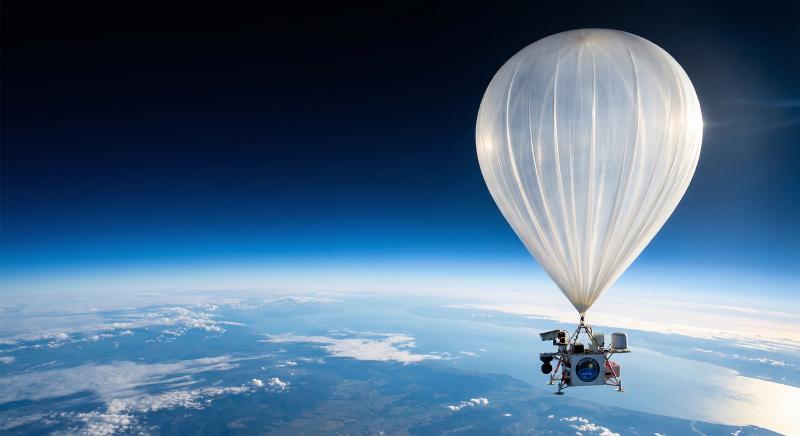
- At 80,000–100,000 feet, Earth curves visibly and the sky above turns black
- The latex balloon bursts when it can no longer stretch, automatically deploying the parachute
- GPS trackers transmit coordinates throughout the flight for precise recovery
- The entire flight — launch to landing — typically takes 2–3 hours
What Really Happens When You Send a Balloon to the Edge of Space?
It looks simple.
A balloon. A box. A rope.
But what actually happens when a high-altitude balloon rises toward the edge of space? The physics at work are more dramatic than the quiet launch suggests.
Step 1: Lift Off
The balloon is filled with helium — a gas lighter than air. The density difference between helium and the surrounding atmosphere creates a buoyant force that exceeds the combined weight of the balloon, payload, and parachute.
Net lift at sea level:
- Air density: ≈ 1.225 kg/m³
- Helium density: ≈ 0.1786 kg/m³
- Net buoyancy: ≈ 1.046 kg per cubic meter of helium
A properly inflated balloon with a few pounds of payload rises at roughly 4–6 meters per second — about 15 feet per second, or the speed of a brisk walk. You can watch it climb for a minute. Then it becomes a dot. Then it disappears.
But it keeps climbing.
Step 2: The Climb Through the Atmosphere
As the balloon rises, something important changes: atmospheric pressure drops.
At sea level, pressure is 101,325 Pa (about 14.7 psi). At 30 km (100,000 ft), pressure is less than 1% of that value.
Because the helium inside the balloon is in a flexible latex envelope, it expands to equalize with the dropping external pressure. The balloon gets larger and larger throughout the climb.
How much does it grow?
A balloon that’s roughly 1 meter in diameter at launch may expand to 8–10 meters in diameter at burst altitude — a volume increase of several hundred times.
| Altitude | Approx. Pressure | What’s Happening |
|---|---|---|
| Sea level | 101,325 Pa | Balloon at launch size |
| 30,000 ft (9 km) | ~30,000 Pa | Balloon noticeably larger |
| 60,000 ft (18 km) | ~7,000 Pa | Balloon dramatically expanded |
| 100,000 ft (30 km) | ~1,200 Pa | Balloon near maximum stretch |
As altitude increases:
- Air pressure decreases
- The helium expands continuously
- The balloon grows larger and larger
- Below it, Earth curves
- Above it, the sky begins to darken toward black
Step 3: The Burst
Eventually, the latex reaches its elastic limit. It cannot stretch further.
The balloon pops.
This happens suddenly — from the perspective of any camera on the payload, the transition from smooth ascent to rapid tumbling is instantaneous. The burst typically occurs between 80,000 and 120,000 feet (24–36 km), depending on the balloon size, fill level, and payload weight.
What happens next:
- A parachute — packed into the payload train — deploys automatically
- The payload, freed from the balloon envelope, begins descending
- Descent under parachute is controlled: typically 5–10 m/s (about 1,000–2,000 ft/min)
- The 2–4 lb payload floats gently back toward Earth over 20–40 minutes
The burst altitude is where the most dramatic images are captured: thin blue atmosphere below, black sky above, the curve of Earth clearly visible.
Step 4: Descent and Landing
As the payload descends through the lower atmosphere, GPS trackers continuously transmit coordinates. A chase team — usually following by vehicle — monitors the position in real time and converges on the predicted landing zone.
Typical landing scenarios:
- Open farmland (most common in rural launches)
- Woodlines and tree lines (parachute can snag — plan for this)
- Water (rare with good prediction tools — avoid over water routes)
- Private property (always obtain permission before retrieval)
The landing itself is gentle — a parachuted 2–4 lb payload typically touches down at walking speed. The hardware usually survives intact.
What the Camera Shows
This is the moment that makes HAB missions unforgettable.
When the SD card is pulled and the images are loaded, the camera has recorded something no ground-based photograph can replicate:
- The transition from blue sky to black sky as altitude increases
- The thin, luminous line of atmosphere at the horizon — the limb glow
- The unmistakable curvature of Earth visible above 60,000 feet
- The silent, cloudless stratosphere stretching in every direction
- And then — the burst — followed by a chaotic tumble and the slow swing of descent under parachute
No simulation produces this. This data came from a balloon, a box, and a rope.
Why Balloons Matter Beyond Photography
High-altitude balloons are more than a novelty or a photography platform. They are active research tools used by:
- Climate researchers — measuring greenhouse gas concentrations at altitude
- Meteorologists — the global radiosonde network provides daily atmospheric data
- Astronomers — balloon-borne telescopes operate above most atmospheric interference
- Aerospace engineers — validating avionics, sensors, and materials in near-space conditions
- Educators — giving students direct access to stratospheric science
Structured systems like the SkyReachSupply SKRHAB 1 make this capability accessible without requiring engineering expertise to build from scratch.
The Physics Summary
| Phase | Key Physics |
|---|---|
| Launch | Buoyancy = weight difference between displaced air and helium |
| Ascent | Gas law: lower pressure → balloon volume expands |
| Burst | Elastic limit of latex exceeded at ~100,000 ft |
| Descent | Drag from parachute decelerates payload to safe landing speed |
| Recovery | GPS triangulation guides chase team to landing coordinates |
The Bigger Picture
Not every journey to the edge of space requires combustion.
Some begin with lift, patience, and a well-designed payload. High-altitude balloons are a reminder that exploration doesn’t always roar — sometimes it rises quietly, all the way to where the sky turns black.
Want to experience this yourself? Browse our HAB kits or get in touch and we’ll help you plan your mission.