Stratospheric Platforms as Low-Cost Testbeds: High-Altitude Balloons for Aerospace Engineers
High-altitude balloons provide aerospace engineers a recoverable, repeatable stratospheric test environment at a fraction of orbital cost. Learn payload architecture, lift modeling, and engineering applications.
Key Takeaways
- At 30 km, balloons expose hardware to −60°C, near-vacuum pressure, and elevated UV/radiation
- Slow ascent and recoverable payloads make balloons ideal for avionics and sensor validation
- Thermal management, pressure equalization, and mass budget are primary payload design drivers
- Net lift is approximately 1.046 kg per cubic meter of helium at sea level
- Monte Carlo drift analysis is recommended for recovery planning on engineering missions
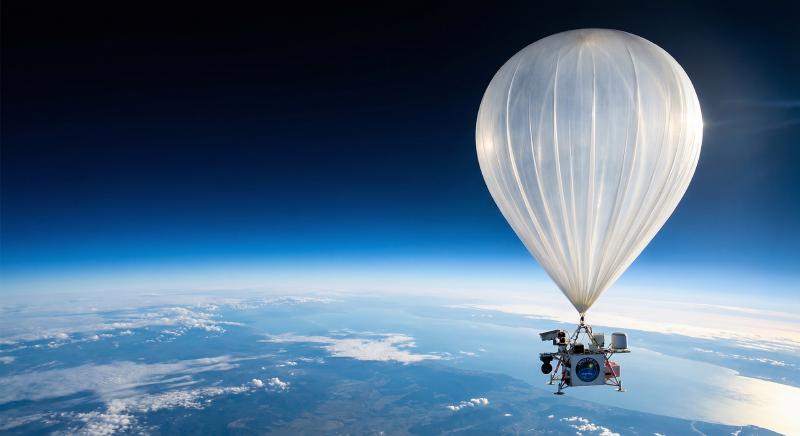
Stratospheric Platforms as Low-Cost Testbeds: High-Altitude Balloons for Aerospace Engineers
High-altitude balloons are often viewed as educational tools.
In reality, they are powerful, low-cost stratospheric test platforms. For aerospace engineers, they provide a controllable, repeatable method to expose hardware to near-space conditions — without orbital launch complexity or the time and cost of chamber-only testing.
The Stratosphere as an Engineering Environment
At 30 km (≈100,000 ft), the environment is substantially different from anything achievable at sea level:
| Parameter | Value at ~30 km | Significance |
|---|---|---|
| Temperature | −55 to −65°C | Lithium chemistry limits, seal behavior, thermal cycling |
| Pressure | ~1,200 Pa (~1.2% of sea level) | Outgassing, pressure differential across sealed enclosures |
| UV intensity | Significantly elevated | Material degradation, solar cell performance |
| Cosmic radiation | Increased exposure | Electronics SEU risk, dosimetry studies |
| Humidity | Near zero | Condensation eliminated; useful for dry-environment testing |
These conditions approximate aspects of low Earth orbit — at a fraction of the cost of orbital access or even sustained altitude aircraft operations.
When Balloons Make More Sense Than Rockets
Sounding rockets offer minutes of microgravity and high dynamic loads. Aircraft test beds don’t reach stratospheric altitude. Orbital launch is expensive and scheduling-constrained.
Balloons offer a different trade:
| Factor | Balloon | Sounding Rocket |
|---|---|---|
| Ascent rate | ~4–6 m/s (slow, controlled) | Hundreds of m/s (high-G) |
| Time at altitude | Minutes to hours | Seconds |
| Payload recovery | Routine | Complex or impossible |
| Shock and vibration | Minimal | Extreme at ignition |
| Cost per mission | Low | Moderate to high |
| Scheduling | Flexible | Fixed launch windows |
For avionics validation, sensor testing, power systems characterization, and communications experiments, the slow, stable balloon ascent profile is often the correct choice. Hardware survives. Data is collected across the full altitude profile. Payloads return for inspection and iteration.
Payload Architecture Considerations
Balloon payloads demand discipline in four areas:
Thermal Management
The stratosphere is cold — sustained exposure to −60°C without thermal management will disable most commercial electronics.
- Lithium battery chemistry outperforms alkaline at low temperatures; use lithium primary or lithium polymer cells designed for cold operation
- Controlled internal heating — resistive heaters with thermostatic control prevent premature shutdown
- Insulation strategy — polyisocyanurate foam or aerogel composite layers minimize passive heat loss
- Active thermal modeling is recommended for any mission where power budget is constrained
Pressure Equalization
Sealed enclosures face an increasing pressure differential as altitude increases. At 30 km, the differential between a sealed 1 atm enclosure and the external environment exceeds 14 psi.
- Venting ports with hydrophobic membrane filters allow pressure equalization while excluding moisture and particulates
- Enclosures designed without venting may rupture during ascent or collapse during descent
- Consider the effect of pressure on any RF components, connectors, and adhesives
GPS and Communication Orientation
- GPS receivers require a clear view of the sky; payload orientation must maintain upward antenna visibility throughout the flight
- Spinning payloads — common after burst — can cause GPS dropout if antenna placement is not designed for rotation
- Consider omnidirectional RF antenna configurations or redundant trackers oriented on multiple axes
Mass Budget Discipline
Every gram matters. Mass directly affects:
- Burst altitude — lighter payloads reach higher altitudes with the same balloon
- Ascent rate — heavier payloads slow ascent and increase drift
- Recovery parachute sizing — heavier payloads require larger chutes, which increase drag during ascent
Maintain a live mass budget from design through integration. Weigh every component.
Modular platforms like SkyReachSupply’s SKRHAB 1 are structured around these constraints — providing a defined mechanical and electrical interface that allows engineering payloads to plug into a proven flight system rather than designing from scratch.
Lift and Performance Modeling
Fundamental Lift Calculation
At sea level:
- Air density: ρ_air ≈ 1.225 kg/m³
- Helium density: ρ_He ≈ 0.1786 kg/m³
- Net lift: (1.225 − 0.1786) × V = 1.046 kg per cubic meter of helium
From this, total volume required is:
V_required = (m_payload + m_balloon + m_parachute + m_rigging + m_free_lift) / 1.046
Target free lift of 300–500g above system weight for a nominal 4–5 m/s ascent.
Burst Altitude Estimation
Burst altitude depends on:
- Balloon diameter rating (from manufacturer spec)
- Fill volume (determines expansion ratio available before burst)
- Atmospheric pressure profile (standard atmosphere or measured NOAA data)
Most engineering missions target 28–35 km burst altitude for stratospheric exposure.
Drift and Recovery Planning
Wind models from NOAA GFS can be queried for the expected flight date and time. Tools like HabHub Predictor provide a baseline single-trajectory estimate.
For engineering missions where hardware recovery is critical, Monte Carlo drift analysis is recommended:
- Run 50–100 trajectory simulations with perturbed wind inputs
- Map the landing zone probability distribution
- Identify recovery risk zones (water, restricted areas, extreme terrain)
- Plan chase team positioning based on the probability centroid
Regulatory Environment
United States
Under FAA Part 101, Subpart D, payloads under 4 lbs (1.8 kg) are generally exempt from advance notification requirements outside of restricted airspace. For engineering missions:
- File a NOTAM regardless of exemption status — it’s good practice and appreciated by regional ATC
- Avoid Class B, C, and D airspace without coordination
- Coordinate with your local FSDO for missions with larger payloads or unusual configurations
See our FAA Part 101 guide for complete regulatory detail.
International Operations
Regulatory requirements vary significantly by country. Some jurisdictions require permits equivalent to experimental aircraft operations. Consult local civil aviation authority guidance for any non-U.S. mission.
Engineering Applications
High-altitude balloon platforms have been used across a broad range of aerospace engineering functions:
| Application | What Balloons Provide |
|---|---|
| Rapid avionics prototyping | Real stratospheric environment, recoverable hardware for iteration |
| Environmental sensor validation | Temperature, pressure, humidity, radiation at altitude |
| Communication systems testing | RF propagation at stratospheric altitude, link budget validation |
| Radiation and UV exposure trials | Elevated natural radiation and UV without orbital access |
| Material durability studies | Thermal cycling, outgassing, UV exposure on candidate materials |
| Camera and optics validation | Image quality, thermal focus shift, vibration effects |
| Power systems characterization | Solar cell performance at altitude, battery thermal behavior |
For early Technology Readiness Level (TRL) validation — particularly TRL 3 through 5 — balloons provide a uniquely cost-effective intermediate step between laboratory testing and flight qualification.
The Strategic Perspective
| Test Environment | Altitude Ceiling | Cost | Duration | Recovery |
|---|---|---|---|---|
| Vacuum chamber | N/A (ground) | Moderate | Hours | N/A |
| Aircraft test bed | ~15 km (50,000 ft) | High | Hours | Yes |
| Sounding rocket | 100–1,000 km | High | Minutes | Rare |
| High-altitude balloon | ~40 km (130,000 ft) | Low | 2–4 hours | Yes |
| Orbital | 200+ km | Very high | Continuous | No |
High-altitude balloons sit at a useful intersection: low cost, real environment, recoverable hardware.
Whether custom-engineered for a specific experiment or built on a structured platform like the SKRHAB 1, stratospheric balloons remain one of aerospace engineering’s most underutilized validation tools.
If you’re evaluating balloon platforms for an engineering or research program, contact us — we can discuss payload integration, mission planning, and system capabilities.