High Power Rocket Certification Levels Explained: L1, L2, L3 Guide
Complete guide to high power rocket certification levels. Learn about Tripoli and NAR certification, motor classes, what each level allows, and how to get certified.
Key Takeaways
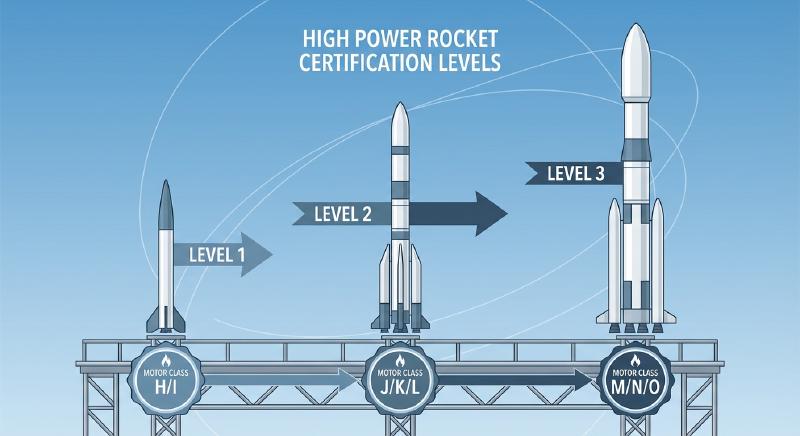
- Level 1 allows H and I motors (up to 640 N-s total impulse)
- Level 2 allows J, K, and L motors (up to 5,120 N-s)
- Level 3 allows M, N, O and above (unlimited impulse)
- Both Tripoli and NAR offer certification programs
- Level 3 requires extensive documentation and flight testing
High Power Rocket Certification Levels Explained
Want to fly bigger rockets? In the United States, high power rockets (HPR) require certification through either the Tripoli Rocketry Association or the National Association of Rocketry (NAR). This guide explains the three certification levels and what each allows you to fly.
Quick Overview
| Level | Motor Classes | Max Impulse | Key Requirement |
|---|---|---|---|
| Level 1 | H, I | 640 N-s | Build and fly successfully |
| Level 2 | J, K, L | 5,120 N-s | Written exam + successful flight |
| Level 3 | M+ | Unlimited | Documentation + committee review |
Motor Class Reference
Before diving into certification, understand motor classifications:
| Class | Impulse Range (N-s) | Common Uses |
|---|---|---|
| A | 1.26 – 2.50 | Small model rockets |
| B | 2.51 – 5.00 | Model rockets |
| C | 5.01 – 10.0 | Model rockets |
| D | 10.01 – 20.0 | Large model rockets |
| E | 20.01 – 40.0 | Large model rockets |
| F | 40.01 – 80.0 | Large model rockets |
| G | 80.01 – 160 | Largest model rocket motor |
| H | 160.01 – 320 | HPR Level 1 minimum |
| I | 320.01 – 640 | HPR Level 1 maximum |
| J | 640.01 – 1,280 | HPR Level 2 |
| K | 1,280.01 – 2,560 | HPR Level 2 |
| L | 2,560.01 – 5,120 | HPR Level 2 maximum |
| M | 5,120.01 – 10,240 | HPR Level 3 |
| N | 10,240.01 – 20,480 | HPR Level 3 |
| O | 20,480.01 – 40,960 | HPR Level 3 |
| P+ | 40,960+ | Advanced Level 3 projects |
Note: Model rockets use A-G motors and don’t require certification. HPR starts at H motors.
Level 1 Certification
What you can fly: H and I motors (160.01 – 640 N-s total impulse)
Requirements:
- Age 18+ (or junior certification available)
- Build a rocket suitable for H or I motors
- Successful certification flight witnessed by two current Level 2 or higher members
- Safe recovery – Rocket must return without damage
What You Need:
- Rocket with 38mm or 54mm motor mount
- Dual-deployment recommended (main + drogue)
- Recovery system (parachute)
- Motor retention system
Level 1 Flight Checklist:
- Pre-flight inspection complete
- Motor installed and retained properly
- Recovery charges tested
- Altitude waiver checked (if required)
- Launch pad set up correctly
- Safe distance maintained
- Successful launch
- Safe recovery
Level 2 Certification
What you can fly: J, K, and L motors (640.01 – 5,120 N-s)
Requirements:
- Current Level 1 certification
- Pass written exam (80% minimum score)
- Build a rocket suitable for J, K, or L motors
- Successful certification flight witnessed by two Level 2+ members
- Safe recovery without damage
Written Exam Topics:
- High power rocket safety codes
- Motor classification and impulse
- Recovery systems and deployment
- Aerodynamics and stability
- Launch procedures
- FAA regulations (Part 101)
Level 2 Rocket Requirements:
- Electronics bay for dual-deployment
- Redundant recovery systems
- Stronger construction (fiberglass or carbon fiber)
- 54mm or 75mm motor mount typical
- Altitude tracking recommended
Level 3 Certification
What you can fly: M motors and above (5,120+ N-s), essentially unlimited
Requirements:
- Current Level 2 certification for at least 1 year
- Submit detailed documentation packet including:
- Design drawings and specifications
- Stability analysis (CG/CP calculations)
- Structural analysis
- Recovery system design
- Motor selection and thrust curve analysis
- Launch and recovery procedures
- Committee review – Level 3 committee reviews your packet
- Build the rocket as documented
- Successful certification flight with committee witness
- Safe recovery without damage
Level 3 Documentation Required:
Design Packet:
- Nose cone design and material
- Airframe specifications (diameter, length, material)
- Fin design and attachment method
- Motor mount and retention
- Recovery bay design
- Electronics layout
Analysis:
- Stability margin (caliber)
- Fin flutter analysis
- Recovery sizing calculations
- Descent rate calculations
- Motor thrust-to-weight ratio
Build Documentation:
- Photos of construction
- Materials list
- Weight and balance
- Electronics testing
- Recovery system testing
Certification Organizations
Tripoli Rocketry Association
- Focus: High power and experimental rocketry
- Membership: $75/year adult, $30/year junior
- Prefers: Fiberglass/composite construction
- Allows: Experimental (EX) motors at Level 2+
National Association of Rocketry (NAR)
- Focus: All levels of rocketry, education-focused
- Membership: $69/year adult, $25/year junior
- Prefers: Standard commercial motors
- Insurance: $5 million liability included
Which to Choose?
- Tripoli if you want to fly experimental motors or advanced composites
- NAR if you want broader club availability and educational focus
- Both if you want maximum flexibility (many join both)
Getting Certified: Step-by-Step
1. Join an Organization
- Sign up with Tripoli or NAR
- Find your local club (prefect/chapter)
- Attend launches to meet members
2. Build Your Certification Rocket
- Start with a proven kit design
- Don’t overcomplicate Level 1
- Use quality materials
- Test electronics before flight day
3. Attend a Launch
- Find a certified launch event
- Bring your rocket and membership card
- Request certification flight
- Have two Level 2+ witnesses
4. Fly Successfully
- Follow all safety procedures
- Ensure stable flight
- Recover without damage
- Get witness signatures
5. Submit Paperwork
- Fill out certification form
- Include witness signatures
- Submit to certifying organization
- Receive certification card
FAQs
Can I build my own rocket? Yes! Kits are recommended for Level 1, but scratch builds are allowed and common at Level 2+.
How much does certification cost?
- Membership: $69-75/year
- Certification flight: Usually free at club launches
- Rocket: $150-500 for Level 1, $500-2000+ for Level 2/3
- Motors: $50-150 (L1), $150-400 (L2), $400+ (L3)
How long does certification last? Lifetime for that level, but you must maintain organization membership to purchase HPR motors.
Can I fly at any launch? You can fly at any sanctioned launch appropriate for your certification level and within FAA altitude waivers.
What’s the hardest part? Most failures occur in recovery. Master dual-deployment and you’ll succeed.
Summary
Start with Level 1 using a proven kit, pass the Level 2 exam to fly bigger motors, and work toward Level 3 for serious high-power projects. Join both Tripoli and NAR for maximum flexibility, and always prioritize safety.
Ready to launch? Shop our Level 1 Certification Kit to get started.