FAA Part 101 Regulations for High Altitude Balloons: Complete Guide
Understanding FAA Part 101 regulations for high altitude balloon launches. Learn about the 6-pound rule, NOTAM requirements, airspace restrictions, and how to fly legally in the US.
Key Takeaways
- Understand the 6-pound payload exemption rule
- Learn when you need to file a NOTAM
- Know the airspace restrictions around airports
- Requirements for payload marking and recovery
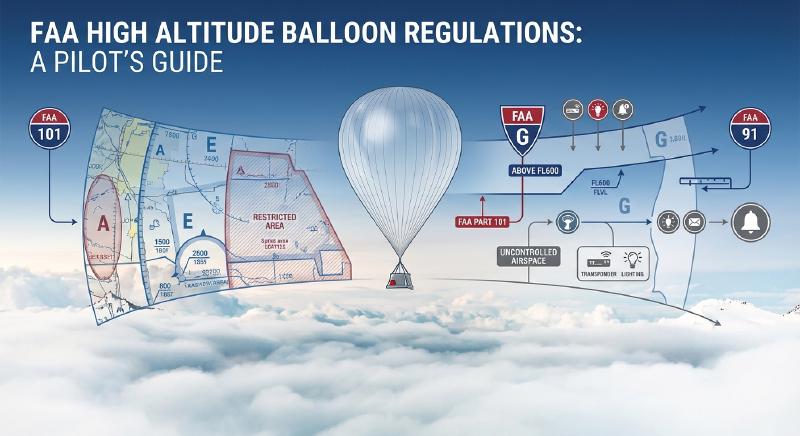
FAA Part 101 Regulations for High Altitude Balloons
Launching a high altitude balloon (HAB) in the United States falls under FAA Part 101 regulations, specifically Subpart D – Unmanned Free Balloons. This guide breaks down everything you need to know to launch legally and safely.
The 6-Pound Rule (Most Important)
If your payload weighs less than 6 pounds, most Part 101 regulations don’t apply to you. This is the exemption that allows hobbyists and students to launch without extensive FAA coordination.
Payload Exemption Criteria
To qualify for the exemption under §101.1(a)(4), your payload must meet all of these:
- Under 6 pounds total – The entire payload package must weigh less than 6 lbs (2.7 kg)
- Weight/size ratio – If over 4 lbs, the package must not exceed 3 oz per square inch on any surface
- Multiple packages – If flying multiple packages, each must be under 6 lbs, and the total weight of all packages under 12 lbs
If you meet these criteria, you are exempt from:
- Advance FAA notification
- NOTAM filing requirements
- Specific equipment requirements
When You DO Need to Notify the FAA
If your payload exceeds the exemptions above, you must comply with §101.35 – Advance Notification:
- File notification at least 24 hours before launch
- Contact the FAA ATC facility with jurisdiction over your launch area
- Provide: launch location, estimated time, predicted trajectory, and maximum altitude
Airspace Restrictions (Critical)
Even with a sub-6-lb payload, you cannot launch in certain areas:
Prohibited Airspace
- Class B, C, or D airspace – Around major airports (without ATC authorization)
- Within 5 nautical miles of any airport (without coordination)
- Restricted areas – Military or other designated zones
- Above clouds – Cannot launch where cloud cover exceeds 50%
Using Sectional Charts
Always check a VFR Sectional Chart before launching. Use tools like:
- SkyVector (free online)
- ForeFlight
- FAA’s B4UFLY app
Look for:
- Airport symbols (towered and non-towered)
- Restricted areas (R-###)
- Military operations areas (MOAs)
- Class B/C/D airspace rings
NOTAM Requirements
A NOTAM (Notice to Air Missions) alerts pilots to your balloon. Required when:
- Payload exceeds exemption limits
- Balloon has lighted visibility
- Flying in certain controlled airspace
File through:
- Leidos Flight Service (1-800-WX-BRIEF)
- Online at 1800wxbrief.com
Include:
- Launch site coordinates
- Time window (usually 2-hour block)
- Maximum altitude
- Balloon description
Payload Marking Requirements
All unmanned free balloons must have:
- Operator identification – Name and contact information
- Registration marking (if required)
- Reflective tape – For nighttime visibility
Mark your payload with a permanent label showing:
UNMANNED FREE BALLOON
Operated by: [Your Name]
Contact: [Phone/Email]
If found, please contact operator
Launch Day Checklist
Before Launch:
- Check weather (winds, clouds, visibility)
- Verify airspace clearance with sectional chart
- File NOTAM (if required)
- Inspect balloon for damage
- Test GPS tracker
- Confirm payload is securely attached
- Have recovery plan (vehicle, chase crew)
During Flight:
- Track balloon position
- Monitor for burst
- Record maximum altitude
- Begin recovery when descending
After Recovery:
- Retrieve all payload components
- Clean up launch site
- Report any incidents to FAA (if required)
- Share data and photos!
Penalties for Non-Compliance
Flying outside Part 101 regulations can result in:
- Civil penalties up to $32,666 per violation
- Certificate suspension (for certificated pilots)
- Criminal charges in extreme cases (endangering aircraft)
Resources
Summary
For most hobbyist HAB launches:
- Keep payload under 6 lbs – Exempts you from most rules
- Check airspace – Avoid airports and controlled airspace
- Mark your payload – Include contact information
- File NOTAM if required – Over 6 lbs or in controlled airspace
- Have a recovery plan – You’re responsible for retrieving your payload
Questions? Contact your local FAA FSDO (Flight Standards District Office) for clarification on specific situations.